
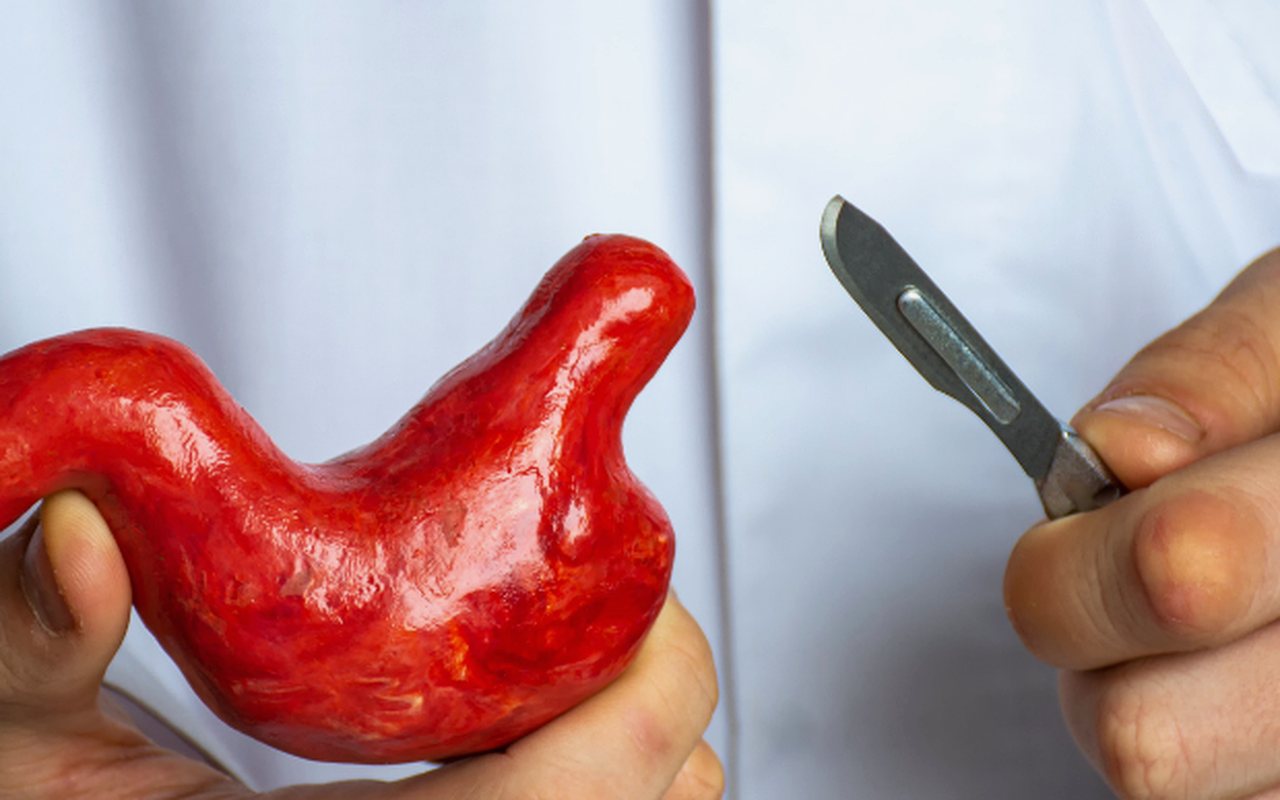
Hiatal hernia surgery
The stomach is returned to the abdomen, the hiatus is closed and an anti-reflux valve is built from the gastric fundus itself.
See the procedure
Burning behind the breastbone, acid regurgitation, chronic cough and morning hoarseness. Most cases are controlled with medication; a proportion needs surgery.
The hiatus is the opening in the diaphragm through which the oesophagus passes into the abdomen. When it widens, part of the stomach rises into the chest — that is a hiatal hernia — and the mechanism that stops gastric contents rising is lost. The clinical result is gastro-oesophageal reflux disease, GERD.
Two things that are often confused are worth separating. Having a hiatal hernia does not necessarily mean having reflux: there are small hernias that cause no symptoms and are found by chance. And having reflux does not necessarily mean having a hernia: it may be due to an incompetent sphincter, to obesity or to eating habits. Which is why investigation matters more than a diagnosis handed over a counter.
The key study is endoscopy, which looks directly at the lining of oesophagus and stomach, allows biopsies and documents the real damage. When surgery is considered, functional studies are added: manometry, which measures how the oesophagus moves, and 24-hour pH monitoring, which confirms that the symptoms genuinely correspond to acid reflux episodes.
The procedures that may be indicated for this condition. Which one applies to you — if any does — is decided on your imaging and your examination.
The stomach is returned to the abdomen, the hiatus is closed and an anti-reflux valve is built from the gastric fundus itself.
See the procedure
Reflux is operated on for its consequences, not for its name. The decision is made with endoscopy and functional studies.
See the procedure
It restricts and also changes the path food takes. It is the procedure with the strongest effect on diabetes and on reflux.
See the procedure
The ulcer is treated with medication; its complication is operated on. A gastric tumour is operated on with oncological criteria.
See the procedureSEVERE ABDOMINAL PAIN THAT DOES NOT LET UP, fever with pain in the right side of the abdomen, VOMITING THAT PREVENTS KEEPING FLUIDS DOWN, distension with no gas or bowel movements, A HERNIA THAT HAS TURNED HARD AND CANNOT BE PUSHED BACK IN, or vomiting or stool WITH BLOOD. Go to an emergency department immediately and call (662) 282-1787.
It is a concern raised with reason and it deserves a nuanced answer. Proton-pump inhibitors are safe and highly effective medicines, and for many patients the benefit clearly outweighs the risks of prolonged use. That said, taking them for decades is not trivial and it is one of the legitimate reasons a young patient may prefer surgery. That decision is discussed, not imposed.
No. It is an anatomical defect of the diaphragm and no exercise closes it. What does help control the symptom is losing weight, because it reduces the intra-abdominal pressure pushing the stomach upwards.
It is a change in the lining of the lower oesophagus from chronic acid exposure. It is diagnosed only with endoscopy and biopsies, not from symptoms, and it implies scheduled endoscopic surveillance. Its presence changes the conversation about treatment.
The best-supported ones: losing weight where there is overweight, eating dinner at least three hours before bed, raising the head of the bed — not using more pillows, raising the bed head — stopping tobacco and reducing alcohol. Lists of forbidden foods are far less useful than commonly believed and vary greatly from person to person.
One consultation with your ultrasound or CT in hand is worth more than ten internet searches. Book by phone or through the form and you will be told what is there, what it means and what your options are.